
Maria Ali Asghar
American University of Sharjah
Introduction
In a world where the internet never sleeps, and every scroll exposes us to a dizzying array of global cultures, Karachi’s underground music scene thrives in the shadows- alive, rebellious, and fiercely original. It is a world of back-alley gigs, secret WhatsApp invites, and genre-blending beats that both echo and resist the forces of globalization. This music does more than entertain; it tells stories, builds community, and confronts cultural homogenization head-on. While globalization has stitched cultures closer than ever before, it has also brought with it a clash of identities, leaving pockets of resistance pulsing through the underground- an electrifying response to the homogenizing forces of cultural globalization.
This paper situates itself in defining globalization as the intensifying global flows of people, ideas, technology, and media that compress time and space and reshape local cultures and identities (Appadurai, 1996; Steger, 2020). These flows are not always smooth or welcomed. They often bring friction, especially in societies grappling with conservative constraints and rapid modernization.
This paper also draws on key concepts such as hybridization and glocalization. Hybridization refers to the blending of global and local cultural forms into new, hybrid identities and practices, while glocalization emphasizes how global flows are adapted to fit local contexts. In Karachi, underground musicians rework global genres, such as hip-hop, techno, or electronica, into localized expressions shaped by Pakistan’s social, political, and linguistic realities. These frameworks provide a lens for understanding how underground music both absorbs and resists globalization.
Therefore, this research argues that Karachi’s underground music scene functions as a dynamic space of resistance shaped by and responding to globalization. Anchored in Pakistan’s turbulent history of state censorship, particularly during General Zia-ul-Haq’s martial law, and propelled by the democratizing force of digital media, underground music in Karachi reflects the tensions between local identity and global influence. It is within this contradiction that a new hybridized cultural expression is born: one that challenges elite dominance, bridges class divides, and resists the commercialization of tradition.
Through a closer look at the historical repression of music under Islamization, the rise of digital platforms, the class-based fragmentation of the music scene, and the impact of corporate-sponsored music programs like Coke Studio, this paper traces how Karachi’s underground musicians turn sound into resistance. By doing so, it explores how cultural globalization is never a one-way street, but a negotiation, a remix, and a rebellion. Set against the backdrop of censorship, oppression, and societal expectations, this research underscores an undeniable truth: sometimes, the loudest voices are born underground.
The Roots of Resistance: Zia-ul-Haq’s Martial Law and its Aftermath
The roots of Karachi’s musical resistance lie in the authoritarian moment of 1977, when on the night of July 4, amidst the political chaos of public discontent, General Zia ul-Haq declared martial law in Pakistan. In the months that followed, his regime banned alcohol, night clubs, dance halls, cinemas, and bars, while imposing strict censorship on art and entertainment (Amier & Maher, 2013). By banning the public sale and consumption of alcohol, Zia effectively forced a once booming nightlife, where music was a driving force, underground overnight. His Islamization policies sought to enforce a singular, conservative vision of Islam, reshaping not only Pakistan’s political order but also public attitudes towards art in ways that endure today. As Paracha (2010) observes “Several attempts were made to artificially mold Pakistan into a single national and religious concept”.
Figure 1. A rare photo of Karachi’s famous nightclub scene of the 1960s and 70s

Source: Archival Photo, photographer unknown
Zia’s Islamization represented a classic case of grobalization, where a centralized authority imposed a homogenized cultural framework. By branding music as ‘un-Islamic’, his government attempted to overwrite Pakistan’s rich cultural diversity with a singular, state-sanctioned identity. Public concerts and music programs on state-run PTV were replaced with religious programming, with the limited music allowed “punctuated with conservative subject matter and imagery such as loud demonstrations of faith, family values, the glory of the armed force, etc” (Paracha, 2010, para. 8).
Before 1977, Karachi had ben a cosmopolitan where Western rock, Bollywood- inspired pop, and classical qawwali coexisted. Artists such as Ahmed Rushdi ( arguably the first disco star of his generation) and Irene Perveen shaped local popular culture, while global figures like jazz pianist Dave Brubek and rock band The Ventures performed in Pakistan as part of a wider cultural exchange (Paracha, 2010). Under Zia, these flows were constricted, pushing artists and audiences into underground networks.
Figure 2. Band known as The Beatles of Pakistan: The Bugs playing at a gathering in the 60s

Source: Sony Rehman (2013)
The suppression of music did not erase its presence; it transformed it into a tool of resistance where the underground emerged as a counter-cultural space. It is also pertinent to mention that certain traditions such as Sufi qawwali at shrines, survived through this homogenization. These spaces framed music as devotional rather than entertainment, allowing it to persist in semi-private settings despite official bans (Amier & Maher, 2013). As Schimmel (1975) notes, the Sufi musical tradition often endured political repression precisely because they blurred the line between faith and art. Thus, even in the darkest years of censorship, Karachi’s underground inherited a living memory of creative resilience and a remarkable ability to survive and adapt.
Figure 3. Karachi’s first girl band in the 60s: The Xavier Sisters

Source: D’Souza (2017)
Underground networks in Karachi adapted by using private venues to discreetly fuse global influences with local realities. Bands and solo artists, often influenced by Western rock and roll, adapted their music to reflect the political and cultural tensions of the Zia era. The underground became a safe space for expressing dissent, where music was both an escape and a subtle critique of the regime. Early work by bands like Vital Signs, which Paracha (2013) describes as part of a risky pop movement that flourished despite repression, emerged from this underground context and resonated deeply with young audiences disillusioned by the stifling cultural environment. These networks fostered hybridization, by blending rock, jazz, and electronic genres with local themes, producing new sounds that spoke to a generation yearning for freedom.
The creative tactics forged in this era; secrecy, self-reliance and hybridized soundscapes, laid the foundations for Karachi’s future digital rave economy. Even in the darkest years of censorship, the underground scene inherited a living memory of resilience, adapting global influences into localized forms of cultural resistance.
Figure 4. Pop and Rock band ‘Vital Signs’

Source: Wikipedia (n.d.)
The Digital Turn: Platform Migration and Re-opening Global Flows
When Pakistan’s last public “Battle of the Bands” TV show was cancelled in 2012, many pundits declared the country’s indie music moment over. What those commentators missed was a silent migration already under way: Karachi’s underground promoters were leaving the public square of Facebook events and pivoting to encrypted invitation-only channels. This move, which Solomonik and Heuer (2025) call “platform migration” (Solomonik & Heuer, 2025), proved decisive from the scene’s survival and subsequent renaissance.
Throughout the 2010s, gigs were announced on Facebook with digital flyers and maps, making them easy targets for police raids. Authorities in Karachi’s District South raided at least fifteen shows between 2014 and 2018 under Section 144 of the Criminal Procedural Code which bans ‘unlawful assembly’ after midnight (Express Tribune, 2014; News Desk, 2025). By 2019, most promoters had moved to closed Telegram channels, sharing venue details with 300-500 verified followers only hours before a set begins. Many gatherings become “invite-only events… (hosted) in private homes, or private parties posed as pop-ups that merge the coexisting worlds of music, fashion and art” (Jamshed, 2019, para. 7).
Promoters also rotated events across unconventional venues like coworking spaces, banquet halls, and unused industrial sites to avoid enforcement. For example, Boiler Room’s first-ever broadcast from Pakistan in June 2022 features performances in unique settings, highlighting the adaptability of the scene (Boiler Room, 2022).
Figure 5. DJ Lyla’s set at Boiler Room Pakistan in 2022
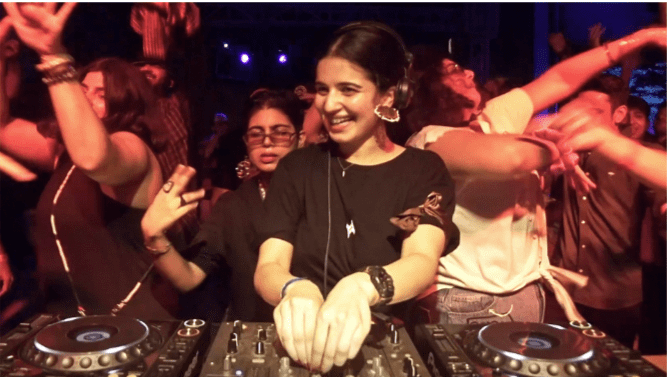
Source: Boiler Room (2022)
The resurgence of Karachi’s rave culture is also fueled by its diaspora. Pakistani expatriates in Dubai, London, and Toronto increasingly fund, promote, and even headline underground gigs back home. Acts like Jaubi, a Lahore-based instrumental collective blending Eastern classical music with experimental jazz, gained international recognition partly through diaspora amplification (Kalia, 2021). Their rise exemplifies Appadurai’s concept of the ‘mediascape’: cultural images and narratives circulating transnationally, connecting underground Karachi artists to global audiences.
Social media has further accelerated this feedback loop. Clips from Karachi raves shared on Instagram and TikTok rapidly accumulate international attention, reinforcing the city’s reputation as an emerging hub for alternative music in South Asia. This global visibility empowers local artists, but also subjects them to new pressures of branding and performative authenticity.
While encryption and mobility theoretically democratized access, they also deepened existing class divides within Karachi’s underground. Upper-middle-class promoters could afford high-speed internet, imported sound systems, and fintech services like SadaPay for ticket sales (Sami, 2025). In contrast, lower-income rappers and DJs, particularly those from Lyari and working-class areas, often relied on informal cash payments, exposing them to police extortion and fewer protections. This gap is evident in the different musical outputs as well: wealthier collectives tend to draw from global genres like techno, house, and drum-and-bass, while lower-income artists blend street rap, Urdu poetry, and folk melodies into forms of resistance that speak directly to their socio-economic realities (Baloch, 2022).
As the underground scene expanded, it inevitably attracted corporate attention. Coke Studio in particular has become the dominant platform in Pakistan’s mainstream music industry where “a musician is not considered mainstream unless he or she has performed in Coke Studio” (Azhar, 2020). While multinational corporations like Coca-Cola have long dominated Pakistan’s mainstream music scene, smaller brands also began quietly sponsoring underground events, offering LED screens, sound equipment, or free drinks in exchange for subtle branding (Azhar, 2020). While such partnerships improved production quality, they risked diluting the authenticity of underground spaces, reflecting Ritzer’s (2007) critique of globalization as a process of cultural homogenization.
Yet Coke Studio’s influence is not entirely negative. Although critics argue it transforms soulful folk traditions into sanitized pop spectacles, the show has also introduced regional languages and folk musicians to both national and global audiences. In this sense, Coke Studio occupies a dual position: it amplifies marginalized traditions and artists while simultaneously embedding them within corporate logic. This tension complicates the narrative of commercialization, revealing how underground and mainstream circuits continually blur in Pakistan’s evolving music culture.
On the other end, Karachi’s underground artists continue to hybridize global influences with Pakistani sounds to create unique musical tracks. A particular sound that has emerged from the music scene in Karachi is electronica with incorporations of Pakistani sounds and Urdu literature. Artists such as Faisal Baig and Lyla are hidden gems that dominate this sound (Bhattacharya, 2018). This fusion of electronic music with Sufi Qawwalis and local instruments creates a unique soundscape that embodies hybridization while resisting commercial capitalism.
Despite tactical innovations, legal frameworks have remained largely static. Section 144 continues to restrict gatherings, and colonial-era laws like the West Pakistan Loudspeaker Ordinance of 1965 remain key tools for policing public gatherings. The ordinance prohibits the use of loudspeakers for “utterances of a controversial nature likely to lead to public disorder, if such utterances are or can be heard outside or beyond the immediate limits” (The West Pakistan Regulation and Control of Loudspeakers and Sound Amplifiers Ordinance, 1965, Section 2(1)(d)).
There has been no legislative shift to support creative underground cultures. Instead, Karachi’s underground scene survives through constant negotiation: exploiting digital affordances, diaspora network, and spatial improvisation. In Appadurai’s (1996) terms, the scene illustrates that globalization is not a one-way imposition but a battlefield where hybrid identities, local resistance, and global flows collide and co-create.
Class Divides in Karachi’s Underground Scene
Another critical dimension of Karachi’s underground music scene is its internal stratification along class lines. While it is often tempting to speak of the ‘underground’ as a single unified space of resistance, the reality is far more complex. Like the broader Pakistani society, the underground music sphere mirrors deep socio-economic inequalities that shape access to resources, audiences, and global connectivity. This section examines the scene through two broad, overlapping categories: the Upper-Class Underground and the Lower-Class Underground. Understanding these distinctions is essential to appreciate how globalization impacts cultural resistance differently across social strata.
The elite segment of Karachi’s underground scene is heavily influenced by global genres and Western musical frameworks. Artists from this demographic typically have access to expensive equipment, formal music education, international exposure, and platforms like Spotify, Bandcamp, and Boiler Room. Their performances often take place at private rooftop gigs, art galleries, boutique cafes, and corporate-backed created spaces, venues that reinforce exclusivity both socially and economically (Farid, 2024).
Musically, English dominates, with many songs written for a cosmopolitan, bilingual audience. While some upper-class artists attempt to localize their sound by incorporating Urdu lyrics or indigenous instruments, these efforts are often aesthetic gestures layered onto fundamentally Western sonic structures. In many cases, the underground elite participate in a feedback loop where global trends shape local production, and local production aspires to global tastes. As a result, the upper-class underground sometimes risks alienating non-English speaking, lower-income Karachiites, reinforcing perceptions of underground music as a playground of the privileged.
This stratification mirrors the theory of “disjuncture and difference” (Appadurai, 1996, p. 27) in cultural flows where even as technology promises connectivity, real access remains uneven. In Karachi’s case, access to the global indie and electronic music circuits is as much about class capital as it is about creative talent.
Moreover, the commercialization of the underground, where affluent collectives secure brand sponsorships and international collaborations, reveals how global aesthetics are reinterpreted through upper-class cultural filters. As Haider (2022) argues, Karachi’s upper-crust music spaces often replicate global coolness without addressing local socio-political realities, thus hollowing out the radical potential of underground movements. Access to international exposure is uneven: upper-class artists leverage festivals, residencies, and transnational networks, while working-class musicians remain rooted in local sounds and struggles. These inequalities reinforce classed access to global visibility, demonstrating how even alternative spaces reproduce broader patterns of privilege
In sharp contrast, the lower-class underground operates through informal, grassroots networks with little institutional support. Without access to polished production studios or major digital marketing platforms, these artists build their audiences organically within Karachi’s working-class neighborhoods.
Artists like Eva B, the groundbreaking female rapper from Lyari, embody this dynamic hybridity. Her “musical journey began when she got a computer with a folder of songs by Eminem” (Baloch, 2022, para.7), illustrating how globalization reaches marginalized spaces, not through elite programs, but via second-hand media, pirated MP3s, and diasporic networks. Rather than passively copying American hip-hop, she localizes and reshapes it to articulate Karachi’s struggles with poverty, violence, gender discrimination and political neglect.
Figure 6. Rapper Ava B in Lyari
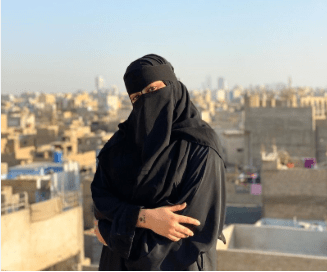
Source: Hassan (2022)
Songs in this scene are often performed in Urdu, Balochi, or Sindhi, giving voice to the lived experiences of the city’s disenfranchised communities. Their sonic textures blend raw beats with traditional rhythmic patterns, graffiti art with calligraphy, and storytelling with political protest. Unlike the upper-class underground, which leans toward aesthetic cosmopolitanism, the working class represents a localized flow of global hip-hop where global forms are reimagined through local struggles (Alim, Ibrahim, & Pennycook, 2009; Pennycook, 2007).
Importantly, while the lower-class underground resists upper-class dominance and Western cultural hegemony, it does so from within a globalized framework. The very tools and genres they use; beatboxing, rap, and sampling, are products of global cultural flows. Thus, rather than existing outside globalization, Karachi’s working-class musicians inhabit globalization differently: selectively, creatively, and defiantly.
The division between Karachi’s upper and lower class underground scenes complicates any simplistic reading of underground music as pure resistance, revealing that even within spaces of rebellion, power operates unevenly. Access to technology, digital audiences, and financial sponsorship shapes whose voices are amplified globally and whose remain rooted in local struggle. As globalization deepens, these divisions may grow sharper, yet, the lower-class underground’s marginalization can preserve its authenticity and radical potential. This dynamic aligns with the Subaltern Studies framework, which emphasizes how marginalized groups use cultural practices to resist dominant narratives (Guha & Spivak, 1982): in Karachi, lower-class artists engage with global genres like hip-hop not as passive consumers but as active agents, reinterpreting these forms to articulate local struggles and identities, thereby subverting hegemonic cultural flows and creating spaces of resistance within the globalized cultural landscape.
Globalization, Technology, and the Future of Karachi’s Underground
As globalization deepens and new technologies reshape cultural production worldwide, the future of Karachi’s underground music scene stands at a critical crossroads. While digital platforms have historically empowered underground artists to bypass traditional gatekeepers, the next wave of technological change brings both opportunities and new challenges that could redefine the landscape of resistance.
On one hand, advances in technology continue to democratize music production and distribution. Affordable production software, AI-assisted mixing tools, and decentralized streaming platforms offer underground musicians greater autonomy over their sound and audiences. Karachi’s younger generation of artists are increasingly experimenting with AI-generated beats, low-cost home studios, and blockchain-based ticketing systems (Raji & Buolamwini, 2019), finding innovative ways to maintain independence outside corporate structures. Such technologies could help lower barriers for lower-income musicians, enabling wider participation across class lines and fostering even more radical hybridizations of global and local sounds.
However, the same technologies that empower can also constrain. Increased digital surveillance, through social media monitoring, internet shutdowns, and cybercrime legislation, pose real threats to underground organizers. Pakistan’s Prevention of Electronic Crimes Act (PECA) has already been criticized for its vague definitions of ‘objectionable’ content, leading to fears that music promoting alternative identities or political dissent could be targeted (Digital Rights Foundation, 2023). In a future of heightened surveillance, encrypted platforms like Telegram may no longer be safe havens, forcing underground communities to devise even more clandestine strategies for survival.
Moreover, the commercialization of underground culture is likely to accelerate. As global brands seek authenticity to market to young consumers, the gritty, hybrid aesthetics of Karachi’s underground scene are at risk of being commodified and stripped of their radical edge (Hesmondhalgh, 2013). International platforms like Boiler Room and Spotify, that once offered visibility to marginalized artists, now increasingly prioritize commercially viable acts, sidelining the more politically subversive voices. Without critical safeguards, globalization could transform resistance into mere lifestyle branding.
Yet if Karachi’s history shows anything, it is the underground’s capacity for adaptation. From surviving martial law to navigating digital migration, Karachi’s underground musicians have continually adapted, embodying what Appadurai (1996) describes as the creation of new cultural forms in deterritorialized spaces. The next era of resistance will likely be even more hybridized: blending encrypted digital activism with grassroots physical gatherings; creating glocal cultural products that resist both state repression and corporate co-optation.
In this emerging reality, the tension between visibility and vulnerability will define the future of Karachi’s underground music scene. Artists and organizers will have to walk a delicate line between global reach and local rootedness, innovation and authenticity, and connectivity and secrecy. The underground’s survival will depend not merely on technological adaptation, but on its continued commitment to community-building, cultural hybridity, and refusal to conform to homogenizing forces.
Ultimately as globalization intensifies, Karachi’s underground music scene will remain not only a reflection of the city’s social fractures but also a laboratory for imagining new, subversive futures where sound, space, and solidarity continue to resist easy assimilation.
Conclusion
The evolution of Karachi’s underground music scene, viewed through the lenses of globalization and resistance, paints a vivid portrait of a subculture built on contradiction and resilience. From the oppressive shadows of General Zia-ul-Haq’s martial law to the expansive possibilities of the digital age, underground music has transformed itself as both a site of defiance and a dialogue with global influences. Concepts such as globalization, glocalization, and cultural imperialism reveal how the scene negotiates forces of homogenization while fiercely asserting local identities and creative autonomy.
This underground movement, however, is far from monolithic. Deep class divides fracture the scene, with upper-class artists often aligned with global aesthetics, elite venues, and English-language platforms, while lower-class musicians remain rooted in localized struggles and indigenous languages. The upper-class underground embraces global hybridity through access to digital resources and international audiences, whereas the lower-class underground reclaims global forms like rap and hip-hop to tell their own stories of poverty, survival, and violence. Yet despite these disparities, both segments contribute to a dynamic and hybrid cultural identity.
Karachi’s underground music continues to resist the pressures of cultural imperialism and corporate homogenization, offering raw, authentic alternatives to dominant cultural narratives. It serves as a living archive where tradition and modernity, local experience and global sounds, coexist in constant negotiation. Through tactical migrations, encrypted platforms, the adoption of pop-up spaces, and diaspora collaboration, underground artists have carved out a resilient cultural ecosystem that adapts without surrendering its core.
As globalization accelerates, Karachi’s underground scene stands as a testament to the enduring power of localized artistic resistance. It defies conformity, amplifies marginalized voices, and reshapes global influences into a soundscape uniquely its own. In a world increasingly flattened by homogenized culture, the beats, rhymes, and melodies emerging from Karachi’s streets offer something rarer: a rebellious, hybridized identity that refuses to be silenced.
Works Cited
Ahmed, B. (2012, August 20). Picturing Pakistan’s Past: The Beatles, Booze And Bikinis. Retrieved from NPR.
Akhtar, S. (2022, August 22). Outrage in Pakistan as Coke Studio breakout star’s home washes away in flash floods. Retrieved from Arab News.
Alim, H. S., Ibrahim, A., & Pennycook, A. (2009). Global Linguistic Flows: Hip Hop Cultures, Youth Identities, and the Politics of Language. New York: Routledge.
Amier, S., & Maher, M. (2013, November 3). The day the music died – why Karachi lost its groove during Ziaul Haq’s regime. Retrieved from The Express Tribune.
Appadurai, A. (1996). Modernity at Large: Cultural Dimensions of Globalization. Minneapolis: University of Minnesota Press.
Azhar, A. (2020, August 14). Pakistan’s Music Industry – A Historical Perspective. Retrieved from Pulse: Asian Music and Dance
Baloch, S. M. (2022, February 13). The rap star of Karachi: ‘My veil cannot take away the talent I have’. Retrieved from The Guardian
Bhattacharya, T. (2018, August 19). Pakistan: Underground scene is music to your ears. Retrieved from The News International
Boiler Room. (2022). DJ Lyla performing at Boiler Room Pakistan 2022 [Photograph]. Boiler Room.
Burki, S. J. (1988, October). Pakistan under Zia, 1977-1988. University of California Press, 28(10), 1082-1100.
Desk, News. (2025, March 24). Section 144 imposed in Karachi. Retrieved from The Express Tribune.
D’Souza, B. (2017, February 11). The Xavier Sisters [Photograph]. Legendary Musicians of Karachi.
Farid, S. (2024, February 20). Karachi At Night | Documentary. Retrieved from Resident Advisor.
Foundation, D. R. (2023). Cybercrime, Surveillance, and Censorship in Pakistan: A 2023 Report. Lahore, Pakistan. Retrieved from Cybercrime, Surveillance, and Censorship in Pakistan: A 2023 Report.
Guha, R., & Spivak, G. C. (Eds.). (1988). Selected Subaltern Studies. Oxford University Press.
Hassan, A. (Photographer). (2022, March 9). Rapper Eva B rehearses a song during an interview on the rooftop of a building in Lyari district, Karachi [Photograph]. AFP via Getty Images.
Hesmondhalgh, D. (2013). The Cultural Industries (3rd ed.). Sage .
Jamshed, M. (2019, November 1). Muted Music — The Private Spaces of Karachi’s Underground . Retrieved from Maekan.
Kalia, A. (2021, April 30). Jaubi: Nafs at Peace review – Pakistani band battle ego with improv Jaubi: Nafs at Peace review – Pakistani band battle ego with improv. Retrieved from The Guardian.
n.d. (2010, October 12). The Musical History of Pakistan. Retrieved from Asia Society.
Paracha, N. F. (2010, December 9). Popping Zia. Retrieved from Dawn.
Paracha, N. F. (2013, March 28). Times of the Signs. Retrieved from Dawn.
Pennycook, A. (2007). Language, Localization, and the Real: Hip-Hop and the Global Spread of Authenticity. Journal of Language, Identity, and Education, 6(2), 101-115.
Raji, I. D., & Buolamwini, J. (2019). Actionable Auditing: Investigating the Impact of Publicly Naming Biased Performance Results of Commercial AI Products. Proceedings of the 2019 CHI Conference on Human Factors in Computing Systems, 429-435.
Rehman, S. (2013, February 8). Old school rock [Photograph]. Sonya Rehman.
Room, B. (2022, June 20). Boiler Room: Pakistan.
Sami, M. (2025, February 18). Scan. Pay. Done — Introducing QR Payments. Retrieved from Sadapay.
Schimmel, A. (1975). Mystical Dimensions of Islam. University of North Carolina Press.
Solomonik, A., & Heuer, H. (2025). Social Media Journeys – Mapping Platform Migration.
Steger, M. B. (2020). Globalization: A very Short Introduction (5th Edition). Oxford: Oxford University Press.
Taj, I., & Ameen, M. (2024). Cultural Reflections In Pakistani Rap Music: A Study Of ‘The Sibbi Song’and ‘Karachi Chal’. Journal of Social Sciences and Humanities, 63(1), 23-58.
The West Pakistan Regulation and Control of Loudspeakers and Sound Amplifiers Ordinance, 1965. (1965, March 2 ). Retrieved from Government of West Pakistan.
Tribune, T. E. (2014, August 13). Beefing up security: Section 144 imposed for today. Retrieved from The Express Tribune.
Unknown. (n.d.). Rare photo of Karachi nightclub in the 1960s–70s [Photograph]. Retrieved from Pinterest.
Vital Signs. (n.d.). Vital Signs [Photograph]. Wikipedia.
 INSpire