
Manal Awadah Mahmoud Al-Zahrani
University of Sharjah
Abstract
This study aims to explore the demographic characteristics of female leaders in Saudi Arabia, identify the cultural and social challenges they face, and propose policies and practices that can contribute to enhancing the role of women in leadership positions. This study coincides with the aspirations of the Kingdom’s Vision 2030, which seeks to empower women and increase their effective participation in various sectors. The study adopted a quantitative analytical approach using questionnaires to collect data from a sample of female leaders. The analysis focused on understanding the reality of women in leadership positions and the challenges they encounter. The results showed that the majority of participants were young, educated women with high levels of education, reflecting the role of education as a fundamental factor in supporting women’s participation in the labor market. However, women face diverse challenges, including discrimination in the workplace and traditional social expectations that limit their opportunities for leadership advancement. The study concluded with the necessity of raising societal awareness about the importance of female leaders, developing training and mentoring programs to empower women, and adopting flexible policies that balance work and life responsibilities. The study also recommends strengthening institutional support and developing research on female leaders to provide a more inclusive and equitable environment.
Keywords
Female Leaders, Vision 2030, Cultural and Social Challenges, Discrimination, Empowerment, Training and Mentoring, Women’s Support
Introduction
The Kingdom of Saudi Arabia has undergone significant social and economic transformation over the past decade through reforms under Vision 2030. This vision provides a roadmap for sustainable development, emphasizing women’s empowerment in all fields, particularly in leadership positions (Al-Rasheed, 2019; Saudi Vision 2030, 2020). Globally, women’s empowerment drives economic and social development, as increased female workforce participation and leadership enhance national economies and foster innovation (Al-Bahrani, 2021). Saudi Arabia aims to align with international standards by achieving gender equality and fair representation of women in decision-making roles.
Riyadh, as a major economic and political center, hosts many female leaders who play a pivotal role in driving development (Al-Maliki & Chandrasapaba, 2021). Empowering female leaders is a central goal of Vision 2030, aimed not only at gender equality but also at enhancing economic and social performance (Vision 2030 Report, 2022). This research analyzes the role of female leaders in Riyadh post-reforms, assesses the challenges they face, and evaluates their achievements (Al-Zahrani, 2023).
Despite progress in women’s participation and leadership, social, cultural, and institutional barriers continue to hinder their full potential in the labor market (Al-Rasheed & Al-Shehri, 2020). Therefore, this study examines the demographics and challenges of Saudi female leaders, identifies potential policy improvements, and explores their contributions to Riyadh’s social and economic development following Vision 2030.
This study holds significant academic value by expanding understanding of Saudi Arabia’s post-Vision 2030 socio-political shifts, particularly in women’s empowerment and social development. Socially, it sheds light on evolving roles of Saudi women within family and society. Economically, it evaluates their impact on labor market outcomes and Vision 2030’s goals, while politically, it highlights the role of government policies in promoting gender equality. The study ultimately offers future-oriented recommendations to enhance women’s leadership and address remaining obstacles. This study aims to address the following research questions:
- What are the demographic characteristics of the study sample?
- What are the cultural and social challenges facing female leaders?
- How can policies and practices be improved to enhance women’s leadership roles in the Kingdom?
- What efforts have female leaders undertaken to support social and economic development in Riyadh?
- To what extent has women’s representation in leadership positions improved in recent years?
Theory
Research Limitations
Methodological Limitations: Reliance on questionnaires for data collection, which may affect the comprehensiveness of the results due to the limited sample size.
Geographical Limitations: Riyadh-centric research limits generalizability to other Saudi cities with different social and political contexts.
Temporal Limitations: This research’s timeframe, focused on Vision 2030’s initial impact, may not capture long-term reform effects.
Cultural and Social Limitations: Saudi social values may hinder honest responses about female leaders’ challenges due to participant hesitancy.
Research Terms and Concepts
Women’s Empowerment: Means enhancing their abilities and opportunities for decision-making and leadership, with equal access to resources.
Female Leadership: Women’s ability to hold leadership roles in institutions, contributing to decision-making and strategies for economic and social development.
Saudi Vision 2030: A strategic plan to diversify Saudi Arabia’s economy, achieve sustainability, and empower women in leadership.
Social Development: Positive changes improving life quality through social justice, gender equality, and increased community and economic involvement.
Economic Reforms: Economic reforms under Vision 2030 aim to improve Saudi’s economy and increase women’s labor market participation through legal and policy changes.
Gender Equality: Equal rights, responsibilities, and opportunities for all genders in accessing resources and participating in decision-making
Cultural and Social Challenges: Obstacles facing Saudi women as a result of social values and beliefs that may limit their opportunities for empowerment and leadership.
Economic Participation: Women’s involvement in the economy through employment in governmental or private sectors, significantly contributing to national economic improvement.
Sustainable Development: Balances economic, social, and environmental needs, ensuring future generations’ opportunities. Women’s empowerment is crucial for achieving these goals.
Government Policies: The measures and programs launched by the state to support women’s empowerment, enhance their leadership role, and facilitate their access to senior positions.
Research-Related Concepts
Saudi Women in Social Development 2030: This concept refers to the increasing role of Saudi women in contributing to the achievement of social development, in line with the Kingdom’s Vision 2030. (Al-Zahrani, M., & Khan, A., 2023).
Vision 2030: A strategic plan established by the Kingdom of Saudi Arabia with the aim to diversify the economy, improve quality of life, promote gender equality, empower women in leadership, and foster a sustainable, prosperous society. (Al-Maliki, S., & Chandnisa, A., 2021).
Theory Explaining the Research Problem: Selection of Two Theories
Modernization Theory: Modernization Theory explains how economic and social development influences societies, particularly in relation to shifting social roles. This theory emphasizes that economic transformations lead to changes in social structures, including the empowerment of women and the enhancement of their role in economic and political life. Within the context of Saudi Arabia’s Vision 2030, this perspective highlights how reforms have propelled women into leadership positions, reflecting a broader shift in societal values and culture. The theory illustrates how the economic reforms introduced under Vision 2030 have stimulated social change, including the rise of women leaders, and it explains the relationship between economic development and women’s empowerment as an integral part of social development (Al-Masoudi, 2020). Moreover, the expansion of higher education and training programs has directly contributed to empowering women and facilitating their entry into the labor market. The younger, educated generation represents a cornerstone in interpreting this transformation, which underscores the accuracy of this theory in explaining the Saudi context after Vision 2030.
Social Role Theory: Social Role Theory explains how individuals’ roles in society are defined by social and cultural expectations. According to this theory, traditional gender expectations shape the roles of men and women within society. However, these roles can shift in response to social and political changes. This theoretical perspective can help in understanding the cultural and social challenges faced by female leaders in Saudi Arabia, as well as the ways in which government reforms under Vision 2030 contribute to reshaping these roles. It interprets the cultural and social barriers that Saudi women may encounter in their pursuit of leadership positions and provides insight into how traditional roles can be redefined through political and social reforms. Linking the theory to reality reinforces the idea that reforms must operate on two parallel axes: transforming societal culture and enforcing strict regulatory policies that guarantee equal opportunities (Al-Otaibi, 2021).
Previous Studies
There have been numerous studies conducted on the role of Saudi women in social development. Among these, Al-Zahrani, M., & Khan, A. (2023) in their study titled “Women in Leadership: Overcoming Challenges in Saudi Arabia” addressed the challenges faced by women in Saudi Arabia when assuming leadership positions and examined how they managed to overcome them. The study aimed to analyze the obstacles hindering women’s advancement in leadership and to explore potential solutions. It concluded that strengthening institutional support and empowering female leaders is essential. The main distinction of the present study compared to this research lies in highlighting the role of Saudi women in social and economic development following Vision 2030.
The Vision 2030 Report (2022), titled “Economic and Social Reforms in Saudi Arabia: Progress and Challenges,” examined major reforms undertaken by the Kingdom in the economic and social spheres within the framework of Vision 2030. The report reviewed the progress achieved in these reforms and the challenges encountered in meeting the defined objectives. Among its findings, the report emphasized the need to enhance integration among different sectors to realize the Vision. The key difference between the current study and this report is the analysis of Vision 2030’s impact on the empowerment of Saudi women in leadership roles and social development.
In a study conducted by Al-Maliki, S., & Chandrasapaba, A. (2021) entitled “The Role of Women Leaders in Economic Development in Saudi Arabia,” the researchers explored the role of female leaders in promoting economic development in the Kingdom and examined the impact of economic empowerment policies on women. The study aimed to highlight Saudi women’s contributions to the national economy and concluded that women’s empowerment directly contributes to economic growth. The present study differs from this research by focusing on the social and political challenges faced by female leaders under Vision 2030.
The study by Al-Otaibi (2021), titled “Saudi Women in Leadership Positions: A Field Study,” investigated how Saudi women attain leadership positions and the impact of their leadership on Saudi society. The study aimed to evaluate the influence of female leadership on social development by conducting interviews with female leaders across various sectors. It concluded that women’s presence in leadership roles strengthens the principle of gender equality and advances development. The distinguishing feature of the present study compared to this research is its focus on the social and political dimensions of women’s empowerment in light of Vision 2030.
Al-Qahtani (2020), in the study titled “The Challenges Facing Saudi Women in Leadership Positions,” examined obstacles hindering Saudi women’s access to senior leadership positions in governmental and private institutions. The study aimed to explore these challenges and provide recommendations to overcome them, concluding that the most prominent challenges are rooted in cultural heritage and a lack of awareness regarding the importance of women’s empowerment in leadership. The present study differs from this research by examining the social and political impact of Saudi women’s empowerment, rather than merely identifying the challenges they face.
The study by Al-Rasheed (2019), titled “Women in Leadership and Economic Growth in Saudi Arabia” or “The Role of Economic Reforms in Enhancing the Empowerment of Saudi Women in the Labor Market,” explored changes in the Saudi labor market under Vision 2030 and their impact on women’s participation. The study analyzed economic policies and their effect on women’s empowerment and opportunities for leadership roles, concluding that economic reforms have significantly increased women’s participation, although cultural challenges continue to hinder their advancement to senior leadership positions. The present study differs in that it highlights the role of female leadership in the social and political development of the Kingdom, rather than focusing solely on economic aspects.
Furthermore, reports by the World Economic Forum (2024) indicated that the Kingdom has made progress in the Economic Participation and Opportunity Index; however, gaps remain at leadership levels. Similarly, the World Bank (2024) highlighted that increasing participation alone is insufficient unless accompanied by policies specifically aimed at promoting women to decision-making positions. Additionally, the Women, Business and the Law (2024) reports noted that although Saudi Arabia’s legal frameworks have undergone substantial improvements, the greatest challenge lies in the practical implementation of these frameworks.
Methods
Research Methodology
The descriptive analytical method: Was employed in the research. Data was collected on the role of women in leadership positions and analyzed using questionnaires to identify challenges and support systems.
Data Collection Tools: Comprehensive questionnaires were used, covering various aspects such as employment status, age group, educational level, and the sectors in which women work. This provided a comprehensive picture of the variables influencing the role of female leaders.
Research Sample
Sample Description: A non-random convenience sample of 91 participants was included, distributed according to multiple factors such as employment status (51.76% employed, the rest unemployed), as well as age group and educational level.
Sample Selection: The sample included women from various sectors and age groups, which enhances its representativeness of the study population. The percentages of participants in the educational, private, health, and other sectors were clarified, which supports the diversity of the sample and enables the generalization of the results.
Data Analysis Methods
Descriptive Statistics: Included the analysis of frequencies and percentages for various variables, which helps in presenting a clear picture of the general situation of women in leadership. For example, the mean and standard deviation were calculated for factors such as age and family support.
Analysis
| What is your current employment status? | Frequencies | % | Mean | Standard Deviation |
| Unemployed | 44 | 48.24% | 45.5 | 2.12132 |
| Employed | 47 | 51.76% | ||
| Total | 91 | 100.00% |
Table 1
Table 1 shows that the percentage of employed women (51.76%) slightly exceeds the percentage of unemployed women (48.24%). This indicates a notable presence of women in the labor market, reflecting a growing interest among women in economic participation.
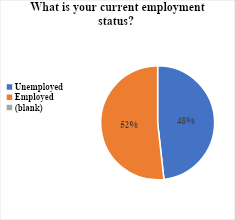
Illustration 1
| Age Group | Frequencies | % | Mean | Standard Deviation |
| 21 – 30 years | 27 | 29.67% | 18.2 | 13.80942 |
| 31 – 40 years | 37 | 40.66% | ||
| 41 – 50 years | 16 | 17.58% | ||
| Less than 20 years | 4 | 4.40% | ||
| More than 50 years | 7 | 7.69% | ||
| Total | 91 | 100.00% |
Table 2
Table 2 shows an age distribution leaning towards the middle age groups, with 40.66% in the 31– 40-year range, followed by 29.67% in the 21–30-year range. This may indicate significant participation of younger adults in the labor market, with proportional representation from older age groups.
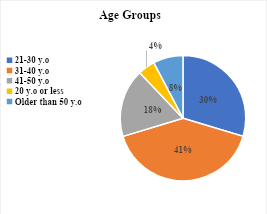
Illustration 2
| Educational Level | Frequencies | % | Mean | Standard Deviation |
| Illiteracy | 9 | 9.89% | 15.16666667 | 15.66418 |
| High School | 15 | 16.48% | ||
| Diploma | 9 | 9.89% | ||
| Postgraduate Studies | 10 | 10.99% | ||
| Other | 2 | 2.20% | ||
| Bachelor’s Degree | 46 | 50.55% | ||
| Total | 91 | 100.00% |
Table 3
The majority of participants hold a Bachelor’s degree (50.55%), indicating a strong correlation between higher education and women’s participation in the labor market. The proportion of postgraduate education (10.99%) also suggests women’s desire for career advancement.

Illustration 3
| Are you currently working in a leadership position? | Frequencies | % | Mean | Standard Deviation |
| No | 60 | 65.93% | 45.5 | 20.5061 |
| Yes | 31 | 34.07% | ||
| Total | 91 | 100.00% |
Table 4
The largest proportion of participants do not work in leadership positions (65.93%), which reveals challenges women face in reaching these roles, possibly due to cultural or social factors. This highlights the ongoing need to address barriers hindering women’s advancement despite the goals of Vision 2030.

Illustration 4
| In which sector do you work? | Frequencies | % | Mean | Standard Deviation |
| Other | 34 | 37.36% | 18.2 | 11.00909 |
| Educational Sector | 25 | 27.47% | ||
| Private Sector | 14 | 15.38% | ||
| Health Sector | 8 | 8.79% | ||
| Military Sector | 10 | 10.99% | ||
| Total | 91 | 100.00% |
Table 5
The largest proportion of participants work in various “other” sectors (37.36%), followed by the educational sector (27.47%). This may suggest a trend of women moving towards diverse fields beyond traditional sectors, aligning with the broader diversification goals of Saudi Vision 2030 which aims to increase women’s participation across various industries.

Illustration 5
| What is the impact of Vision 2030 on the role of female leaders in the Riyadh labor market? | Frequencies | % | Mean | Standard Deviation |
| Positive | 30 | 32.97% | 30.33333333 | 24.5017 |
| Very Positive | 55 | 60.44% | ||
| Neutral | 6 | 6.59% | ||
| Total | 91 | 100.00% |
Table 6
Table 6 shows that regarding the impact of Vision 2030 on the role of female leaders; the majority of women perceive the impact as very positive (60.44%) or positive (32.97%). This reflects the significant influence of Vision 2030 in enhancing the role of female leaders in the labor market.
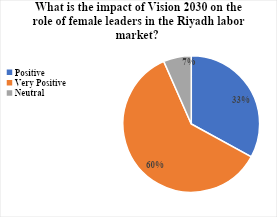
Illustration 6
| What are the cultural and social challenges facing female leaders? | Frequencies | % | Mean | Standard Deviation |
| Other | 16 | 17.58% | 15.16666667 | 5.419102 |
| Discrimination in the workplace | 11 | 12.09% | ||
| Traditional expectations | 20 | 21.98% | ||
| Inequality of opportunities | 11 | 12.09% | ||
| Lack of support from family | 10 | 10.99% | ||
| All of the above | 23 | 25.27% | ||
| Total | 91 | 100.00% |
Table 7
The tables indicate that traditional expectations (21.98%) and workplace discrimination (12.09%) are prominent challenges facing female leaders. This suggests that despite progress, cultural norms and biases still act as significant obstacles hindering women’s advancement into leadership roles in Riyadh.
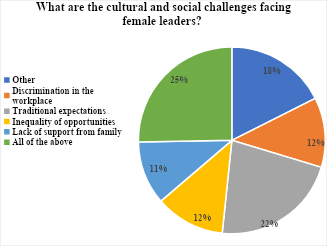
Illustration 7
| How would you describe the level of support that women in leadership positions receive from government institutions? | Frequencies | % | Mean | Standard Deviation |
| High | 41 | 45.05% | 18.2 | 15.92796 |
| Very High | 21 | 23.08% | ||
| Medium | 23 | 25.27% | ||
| Low | 4 | 4.40% | ||
| Very Low | 2 | 2.20% | ||
| Total | 91 | 100.00% |
Table 8
The table shows that 45.05% of women believe the support is high, reflecting tangible efforts to promote women’s empowerment, although a significant proportion perceive the support as medium (25.27%). This suggests that while progress has been made in governmental support for female leaders, there is still room for improvement to elevate the perceived level of support for a larger segment of women in leadership roles in Riyadh.
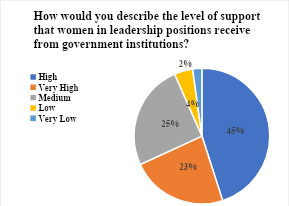
Illustration 8
| How can policies and practices be improved to enhance the role of female leaders in the Kingdom? | Frequencies | % | Mean | Standard Deviation |
| Other | 3 | 3.30% | 15.16666667 | 13.13646 |
| Strengthening women’s networks | 2 | 2.20% | ||
| Providing training and professional development programs | 13 | 14.29% | ||
| Increasing societal awareness | 19 | 20.88% | ||
| Implementing policies to support work-life balance | 16 | 17.58% | ||
| All of the above | 38 | 41.76% | ||
| Total | 91 | 100.00% |
Table 9
Increasing societal awareness (20.88%) and providing training programs (14.29%) are considered among the most important ways to improve policies and practices for enhancing the role of female leaders. This suggests a need to intensify efforts in these areas to empower women in leadership within the Kingdom of Saudi Arabia.

Illustration 9
| What efforts have female leaders madeto support social and economic development in Riyadh? | Frequencies | % | Mean | Standard Deviation |
| Other | 5 | 5.49% | 15.16666667 | 14.57967 |
| Participation in government programs | 8 | 8.79% | ||
| Establishing community initiatives | 15 | 16.48% | ||
| Providing training for other women | 7 | 7.69% | ||
| Supporting small businesses | 12 | 13.19% | ||
| All of the above | 44 | 48.35% | ||
| Total | 91 | 100.00% |
Table 10
The table indicates that women participate in various initiatives to support development. A significant proportion (48.35%) believe that all the listed efforts are important, demonstrating female leaders’ awareness of their developmental role in Riyadh.
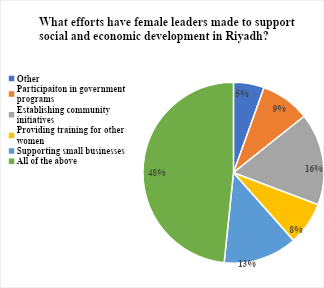
Illustration 10
| Do you believe there have been improvements in the representation of women in leadership positions in recent years? | Frequencies | % | Mean | Standard Deviation |
| No, there has been no change | 1 | 1.10% | 18.2 | 22.25309 |
| Yes, slightly | 6 | 6.59% | ||
| Yes, moderately | 20 | 21.98% | ||
| Yes, significantly | 56 | 61.54% | ||
| I don’t know | 8 | 8.79% | ||
| Total | 91 | 100.00% |
Table 11
A significant proportion (61.54%) perceive a significant improvement in women’s representation [in leadership positions], indicating positive progress towards women’s empowerment in leadership.

Illustration 11
| What is the extent of the impact of family support on women’s success in leadership positions? | Frequencies | % | Mean | Standard Deviation |
| Weak impact | 3 | 3.30% | 30.33333333 | 39.00427 |
| Moderate impact | 13 | 14.29% | ||
| Significant impact | 75 | 82.42% | ||
| Total | 91 | 100.00% |
Table 12
The vast majority (82.42%) believe that family support has a significant impact, highlighting the importance of family support as a fundamental factor in women’s professional success.

Illustration 12
| What factors do you believe enhance women’s empowerment in leadership? | Frequencies | % | Mean | Standard Deviation |
| Other | 3 | 3.30% | 15.16666667 | 17.72475 |
| Legislation and laws | 4 | 4.40% | ||
| Education and training | 20 | 21.98% | ||
| Institutional support | 5 | 5.49% | ||
| Societal awareness | 10 | 10.99% | ||
| All of the above | 49 | 53.85% | ||
| Total | 91 | 100.00% |
Table 13
The table emphasizes the importance of education and training (21.98%), legislation and laws (4.40%), and institutional support (5.49%) in enhancing the role of women in leadership, with 53.85% considering all the listed factors to be of significant importance.

Illustration 13
Conclusion
Discussion of Results
1. What are the demographic characteristics of the study sample?
Based on the tables related to age groups, educational level, and women’s employment status, the demographic characteristics of the sample can be identified. The results show that most participants are between the ages of 31–40 and 21–30 years, and hold higher education degrees, with a large proportion being bachelor’s degree holders. This demonstrates that higher education has become the main driver of women’s empowerment. It also indicates that the sample largely consists of young, educated, and employed women, reflecting the role of education and women’s presence in the labor market as part of the study sample. Nevertheless, the proportion of women in leadership positions does not exceed one-third, revealing a leadership glass ceiling that prevents women from transitioning from general participation to decision-making roles.
2. What are the cultural and social challenges facing female leaders?
The findings confirmed the overlap of barriers between traditional expectations (21.98%) and stereotypical roles on one side, and workplace discrimination and inequality of opportunities (12.09%) on the other, in addition to weak family support (10.99%) in some cases. This overlap reflects the propositions of Social Role Theory, which states that stereotypes about women’s roles remain deeply rooted and continue to influence the distribution of authority within institutions. These challenges highlight the social barriers that may hinder women’s advancement and affect their participation in leadership.
3. How can policies and practices be improved to strengthen women’s leadership roles in the Kingdom?
The results indicated that participants preferred a comprehensive approach that combines raising societal awareness (20.88%), providing specialized training and professional development programs (14.29%), strengthening professional women’s networks, and adopting flexible work policies that accommodate both family and career needs. This aligns with the 2024 updates by the Ministry of Human Resources regarding flexible work arrangements. It is essential to move from the model of mentorship to the model of sponsorship, in which influential leaders advocate for women within decision-making structures and support their advancement toward senior leadership. Moreover, institutional transparency should be enhanced by publishing annual reports on wage gaps and leadership representation.
4. What efforts have female leaders undertaken to support social and economic development in Riyadh?
The study revealed that a large proportion of Saudi female leaders engage in diverse activities, with “all of the above” being selected by 48.35%. These efforts include contributing to government programs, launching community initiatives, providing training for other women, and supporting small and medium enterprises (SMEs). Such contributions serve as a direct mechanism for transforming women’s human capital into added societal value, contributing to improved services and enhanced quality of life. These efforts reflect the positive role of female leaders in supporting both social and economic development and emphasize their influence in advancing society by strengthening women’s leadership roles. Based on these findings, it is recommended to establish a national knowledge repository that documents women’s success stories and initiatives, while providing guiding tools and organizational templates to facilitate their replication across other cities and sectors.
5. To what extent has women’s representation in leadership positions improved in recent years?
The survey results showed that more than 80% of participants perceived either significant or moderate improvement in leadership representation in recent years. This perception is consistent with data from the General Authority for Statistics, which confirmed that the female labor force participation rate reached 36.2% in 2024, surpassing the original target of 30%. Despite this progress, a gap at the senior leadership level persists, as reports by the World Economic Forum (2024) indicate that women remain underrepresented in higher management and decision-making positions compared to men.
The findings reveal that while young, educated, and employed women form the majority of the sample, their representation in leadership remains limited, reflecting a persistent glass ceiling. Cultural expectations, workplace inequality, and weak family support continue to restrict women’s advancement. At the same time, participants emphasized the need for awareness campaigns, training programs, professional networks, and flexible work policies to enhance leadership opportunities. Female leaders are already contributing to social and economic development through community initiatives, SME support, and mentoring, yet senior leadership gaps persist. Overall, progress is evident—particularly in labor force participation—but sustained policies and cultural change are essential to fully realize the goals of Vision 2030.
Recommendations
- Efforts should be intensified to raise awareness about the importance of the female leadership role and to highlight the success stories of female leaders as role models for future generations. This will contribute to changing traditional perceptions and fostering societal acceptance of women in leadership positions.
- Specialized training and mentoring programs must be provided for women aspiring to leadership positions, focusing on building administrative and leadership skills, in addition to providing guidance and support from successful leaders to share their experiences.
- It is essential to adopt flexible policies that help women balance their professional and family responsibilities, by granting paid family leave and providing flexible work options such as remote work.
- To ensure equal opportunities, strict policies must be adopted to prevent discrimination and bias in the workplace and to guarantee a fair environment that allows women to advance and be promoted based on their qualifications and competencies.
- Governmental and private institutions should provide support to female leaders by building women’s networks and facilitating access to financial resources and opportunities available for leadership projects, thereby enhancing their ability to influence society.
- Financial and training support should be provided to women who wish to establish small businesses or community initiatives, which will contribute to strengthening their role in economic and social development and encourage innovation and positive contribution.
- Support more studies and research on the challenges and opportunities facing female leaders to gain a deeper understanding of the issues affecting them and to provide solutions based on scientific evidence and data.
Acknowledgements
Special appreciation is due to Dr. Noura Al Karbi for her expert supervision and oversight of this study.
Special thanks are due to Ms. Yara Kaddoura for her valuable contribution in translating and formatting this study.
References
Al-Ghamdi, A. (2021). Challenges facing Saudi women in the labor market. Studies in Social Development, 10(1), 22–34.
Al-Harbi, M. (2020). Social changes after Vision 2030 and their impact on women’s roles. Arab Journal of Social Studies, 15(2), 78–90.
Al-Masoudi, M. (2020). Economic reforms and their impact on women’s roles in Saudi society. Journal of Women’s Studies.
Al-Otaibi, H. (2022). Empowerment of Saudi women after Vision 2030. Journal of Social and Human Sciences, 18(3), 45–67.
Al-Otaibi, S. (2021). Social Role Theory and its role in understanding the challenges of women leaders. Journal of Social Sciences.
Al-Shammari, S. (2022). The role of education in empowering Saudi women. Educational Studies, 8(3), 55–70.
Khalid, F. (2021). The future of Saudi women in the labor market after Vision 2030. International Journal of Economic and Social Studies, 12(4), 90–112.
General Authority for Statistics. (2023). Annual report on women’s participation in the labor force. Riyadh: General Authority for Statistics.
General Authority for Statistics (GASTAT). (2024). Labor force survey results Q3 2024. Retrieved from https://www.stats.gov.sa
Ministry of Human Resources and Social Development. (2023). Saudi Vision 2030: Empowering women. Riyadh: Ministry of Human Resources and Social Development.
Ministry of Human Resources and Social Development (HRSD). (2024). Updates on flexible work regulations. Riyadh: HRSD.
Saudi Press Agency. (2025). Saudi women’s labor participation reaches 36%. Riyadh: SPA.
United Nations. (2022). Global Gender Gap Report. New York: United Nations.
World Bank. (2024). Gender Data Portal: Labor force participation. Washington, DC: The World Bank.
World Bank. (2024). Women, Business and the Law 2024. Washington, DC: The World Bank.
World Economic Forum. (2024). Global Gender Gap Report 2024. Geneva: WEF.
 INSpire